Where the Millage Meets the Mailbox: Mapping How Each of Illinois' 102 Counties Splits Your Property Tax Bill
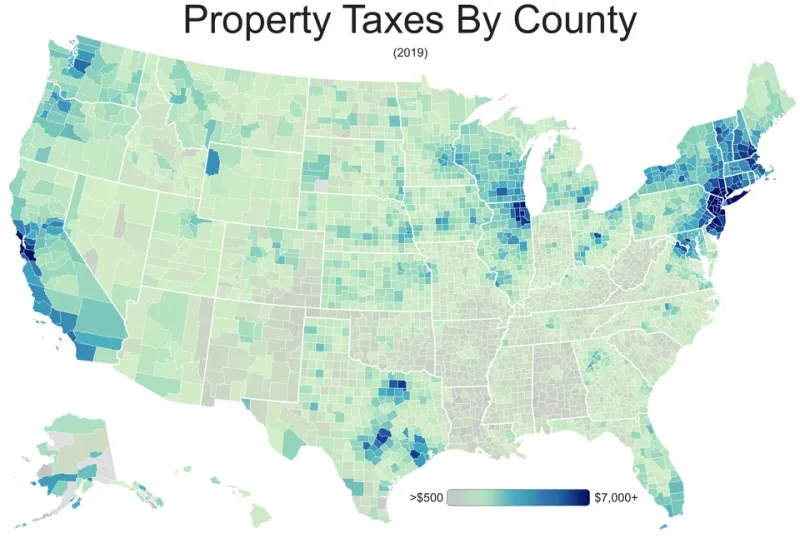
Photo: Wikideas1, CC0, via Wikimedia Commons
A property tax bill is the most expensive document most Illinois households receive each year, and also the least examined. It arrives in spring or summer, lists a bottom line, and invites payment. What it rarely invites is scrutiny. Yet buried in the levy extensions reported by each county clerk is a detailed accounting of who claims what share of the state's roughly $30 billion in annual property tax collections.
We pulled levy data and assessor records from all 102 counties to answer a deceptively simple question: when you pay your property tax bill, who actually gets paid?
The Big Split: Schools First, Everywhere
Across the state, one pattern holds with near-uniformity. Public school districts consume the largest slice of the property tax pie in virtually every county, typically claiming between 55 and 65 percent of the total extension. In suburban counties like DuPage and Lake, the school share sits comfortably in that range. Downstate, where industrial tax bases are thinner, school districts often account for an even larger proportion — in some rural counties, upwards of 70 percent.
This is not a secret, exactly. It is simply arithmetic that rarely gets surfaced. A homeowner in Champaign County paying $6,000 in property taxes is, in practical terms, funding a school system first and a county government a distant second. County general funds, by comparison, usually capture 8 to 12 percent of the bill, with municipalities, park districts, fire protection districts, and libraries dividing the remainder.
The Hidden Layer: Special Service Areas
The most opaque line items belong to special purpose districts. Illinois has more units of local government than any state in the union — nearly 8,000 by recent counts — and many of them levy taxes through mechanisms most residents have never heard of.
Special service areas, or SSAs, allow a subdivision or commercial corridor to tax itself for snow removal, street lighting, or landscaping. They appear on tax bills as cryptic codes. In Cook County alone, dozens of SSAs collect millions annually with minimal public attention. Our review found SSAs in the Chicago suburbs whose per-parcel levies exceed what some residents pay to their municipal government — for services a block association could theoretically negotiate.
Fire protection districts present a similar story outside urban cores. In counties like Jefferson and Saline, fire district levies rival or exceed county general fund levies, a reflection of both genuine service costs and a fragmented governance structure that makes oversight difficult.
The TIF Complication
No accounting of Illinois property taxes is complete without tax increment financing districts. TIFs do not appear as a line item; instead, they divert incremental property tax revenue away from schools, counties, and townships before distribution. Cook County's TIF districts captured more than $1 billion in value in recent years — money that would otherwise have flowed to overlapping taxing bodies.
The effect is regressive in a subtle way: jurisdictions with large commercial tax bases see that growth siphoned into TIF funds governed by municipal boards, while the taxing bodies still providing services absorb the shortfall. Some municipalities have begun retiring TIF districts early and releasing the surplus. Others keep extending.
Look Up Your Own County
To make this concrete, we built a lookup tool pairing each county's latest levy extension with a visual breakdown by taxing body type — schools, municipalities, counties, townships, special districts, and libraries. The data comes from Illinois Department of Revenue levy abstracts and county-level extension reports, the same documents any resident can request under the Freedom of Information Act or find on county websites.
Three things become immediately clear when you use it:
- Fragmentation varies enormously. A taxpayer in McLean County deals with a handful of overlapping bodies; a taxpayer in suburban Cook may fund a dozen.
- Townships matter more downstate — and less in the suburbs — than conventional wisdom suggests.
- The bill is a policy choice. Every line was created by a referendum, a statute, or a board vote, each with a paper trail.
Transparency Starts With the Line Items
Illinois posts a remarkable amount of levy data in public, if scattered across county clerks' offices and state agency databases. The problem is not secrecy; it is presentation. A tax bill that showed a plain-language breakdown — this much to the school district, this much to the fire district, this much diverted to a TIF — would transform an abstract grievance into an informed one.
Until that reform arrives, the records are there for the reading. Start with your county clerk's extension report. Then ask your school board, your township, and your SSA why their slice is what it is. The ledger, as always, is public. It just takes a light to read.