The Disappearing Thread: Illinois' Uneven Rules for Text Messages That Conduct Public Business

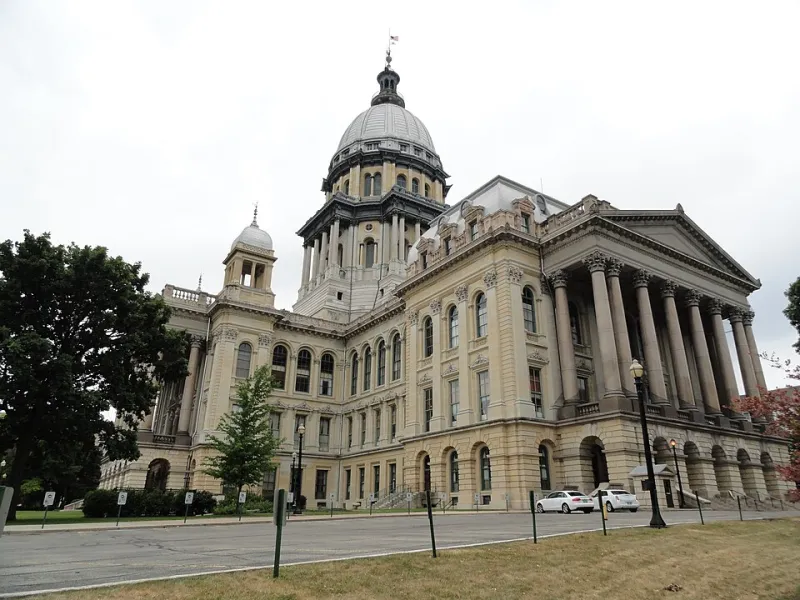
Photo: Thomas Robbin, CC BY-SA 3.0, via Wikimedia Commons
Public business in Illinois increasingly travels through the same apps residents use to schedule dinner: SMS, iMessage, WhatsApp, Signal. That convenience has outrun the paperwork. Under the Illinois Freedom of Information Act, a text about official business can be a public record. Under the Local Records Act, it may also be subject to a retention schedule. But whether that message is captured, stored, and produced often depends on where you live and which device the official used.
A Patchwork of Policies
For this 2026 audit, Illinois Open Gov reviewed the published records and electronic-communications policies of all 102 counties and the state's largest municipalities. The pattern was consistent. Many governments have a general records policy. Few mention text messages at all. Fewer still address personal phones, messaging apps, or the gray zone of a public employee using a private account to conduct public business.
Where text messaging is addressed, the rules diverge. Some offices prohibit it for official business, a clean rule that is hard to enforce. Some permit it only if the employee forwards the message to an official email account, a practice that depends on individual diligence. Others say nothing, leaving clerks and records officers to rely on employees to use good judgment. Retention schedules are often posted separately, if they are posted at all, and rarely translate into a practical capture routine.
The result is not a single statewide standard but a few hundred local ones. A county board member in one county may be required to forward a text to the county clerk within days. A city council member in another may be told only to preserve records subject to the Local Records Act, without guidance on how a text becomes a record. A third may use a personal phone with no written policy in sight.
A Vote, Then a Paper Trail
Policy language matters most after a contested decision. For this audit, we selected a rezoning vote in a suburban Cook County municipality where neighbors packed a board meeting and the outcome turned on a single member. We then filed targeted requests for text messages and messaging-app communications among board members, the administrator, and the zoning official for the seven days before and after the vote.
The responses illustrated the gap. One office produced a set of redacted texts about scheduling and a single message about a constituent question. Another said it had no responsive records, though the official had acknowledged texting during the meeting. A third said the request should go to the individual member because the communication was on a personal device. The clerk's office said it had no way to search a personal phone. One production arrived after the statutory response period; another arrived only after a follow-up that cited the Attorney General's Public Access Counselor.
What survived was not necessarily the most consequential record. It was the record that happened to be captured by habit. That is the core problem with text-message retention in Illinois: the public record is not defined by the importance of the decision. It is defined by whether someone remembered to forward, screenshot, or archive a thread.
Why the Gap Matters
Text messages can reveal the same things paper records do: who was negotiating, what was promised, when a vote was really decided. They can also reveal what the Open Meetings Act is meant to keep visible. A quorum that deliberates by group text may not post a notice, keep minutes, or invite the public. Even when texts do not constitute a formal meeting, they can show influence that never appears in a committee file.
The retention risk is practical. Phones are replaced. Apps auto-delete. Employees leave. A policy that says preserve relevant messages is not the same as a system that captures them. Without a capture routine, the default setting of a personal phone becomes the de facto records schedule, and that default is usually deletion.
What a Model Policy Should Require
A workable policy does not need to be elaborate. It needs to be specific and auditable. Illinois Open Gov's model policy would require:
- A clear definition of public business that includes text messages, chat apps, and personal devices used for official work.
- A presumption that messages about public business are public records, regardless of the device or account.
- A ban on auto-deleting messaging apps for officials and staff who conduct public business.
- A capture method: forwarding to an official account, screenshotting to a records system, or using a managed device that archives messages.
- A deadline for capture, such as two business days, with a designated records custodian.
- A retention schedule that matches the Local Records Act and is posted online.
- Annual training and a signed acknowledgment for officials and staff.
- An annual audit, reported publicly, that samples messages and confirms capture.
The policy should also address vendors. If a government uses a messaging platform for official business, the contract should specify records access, export formats, and retention. A platform that cannot produce a thread on request is a records problem waiting to happen.
A Citizen Checklist
Residents do not need to wait for a model policy to ask harder questions. When public business may have happened by text, a records request can be built around the following checklist:
- Ask for the government's written electronic-communications and retention policies.
- Request messages by date range, sender, recipient, and subject, not just by keyword.
- Ask specifically for personal devices and messaging apps used for public business.
- Request the retention schedule that applies to those messages.
- Ask for a certification that a reasonable search was conducted.
- Keep a log of response dates and follow up in writing.
- If records are withheld or denied, ask for the exemption in writing and consider an appeal to the Public Access Counselor.
- Check meeting minutes and agendas against the dates of the messages.
The Record Is a Choice
Illinois law already says that public business is public business, whether it happens in a conference room or on a phone. The gap is in practice. Counties and cities can close it with plain policies, capture routines, and public reporting. Until they do, the public record will remain uneven, and sometimes it will disappear one thread at a time.